Execution of TQM Facilitator & IT Resources in Indian Industry
Seventeen variables (nine TQM facilitators and eight IT resources), named from 116 studies and ranked by a 21-member expert panel with Interpretive Structural Modelling and MICMAC, then tested on 319 ICT professionals with factor analysis and structural equation modelling. Both TQM facilitators and IT resources relate significantly to customer satisfaction; top-management commitment and electronic data interchange play the major role.
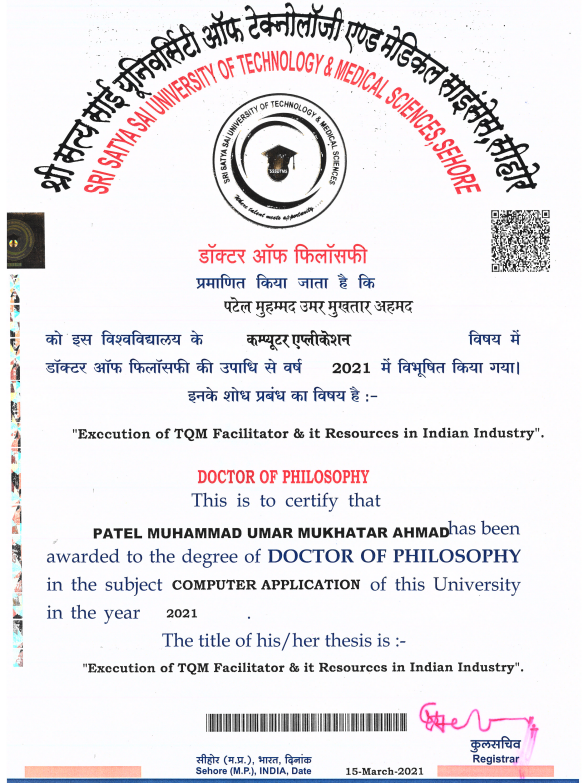
- Degree
- Ph.D., Computer Application
- Conferred
- 15 March 2021
- University
- SSSUTMS, Sehore
- Method
- ISM · MICMAC · EFA · CFA · SEM · ANOVA
What the research set out to prove.
319 usable responses from ICT professionals (managers and engineers), from a frame of 801 NASSCOM-listed companies across IT, software development, BPO and telecom.
- Name the TQM facilitators and IT resources in the ICT industry of India.
- Grade and categorise them, and develop the contextual relationships between them.
- Understand awareness of TQM and IT programmes in the industry.
- Examine the degree to which the facilitators and resources are executed.
- Examine the relationship among the named facilitators and resources.
Drivers versus dependents.
Each variable is plotted by how many others it drives (y) against how many drive it (x). The dashed lines split the field into autonomous, dependent, linkage and driver quadrants. Positions are the thesis’s own matrix sums; coincident points are offset slightly so both stay visible.
| Var. | Name | Group · ISM level | Drv | Dep |
|---|---|---|---|---|
| TMCS | Top Management Commitment & Support | TQM · LVI | 9 | 1 |
| TW | Teamwork | TQM · LV | 8 | 4 |
| CT | Continuous Training | TQM · LV | 7 | 4 |
| CC | Culture Change | TQM · LV | 7 | 7 |
| EMPW | Empowerment | TQM · LIV | 5 | 4 |
| TEI | Total Employee Involvement | TQM · LIV | 5 | 6 |
| DMS | Democratic Management Style | TQM · LIII | 4 | 5 |
| CI | Continuous Improvement | TQM · LII | 2 | 8 |
| CS | Customer Satisfaction | TQM · LI | 1 | 9 |
| SPSS | Statistical Packages for Social Sciences | IT · LVI | 8 | 1 |
| CAD | Computer Aided Design | IT · LV | 5 | 3 |
| CAM | Computer Aided Manufacturing | IT · LV | 5 | 3 |
| ERP | Enterprise Resource Planning | IT · LIV | 4 | 2 |
| CAPP | Computer Aided Process Planning | IT · LIII | 3 | 5 |
| CAE | Computer Aided Engineering | IT · LII | 2 | 6 |
| SEM | Structural Equation Modelling | IT · LII | 2 | 2 |
| EDI | Electronic Data Interchange | IT · LI | 1 | 8 |
What it found.
- Top Management Commitment & Support forms the base of the TQM hierarchy (ISM level VI) and Customer Satisfaction sits at the top (level I); for IT, SPSS is the base and EDI the top.
- MICMAC: TMCS (driving 9) and SPSS (driving 8) are the strongest drivers; Customer Satisfaction (dependence 9) and EDI (dependence 8) are the most dependent. Culture Change and Total Employee Involvement are the only linkage variables.
- Measurement model: Cronbach’s alpha 0.764–0.892; EFA (KMO 0.777) extracted 17 factors explaining 64.04% of variance.
- Structural model: 9 of 16 paths to customer satisfaction are significant: TMCS, CI, TW, EDI, CAD, ERP, CAE, SPSS and SEM.
- Both TQM facilitators and IT resources relate significantly to customer satisfaction (p < .001).
- Conclusion: top-management commitment and electronic data interchange have a major role in the successful execution of TQM and IT.
Peer-reviewed papers.
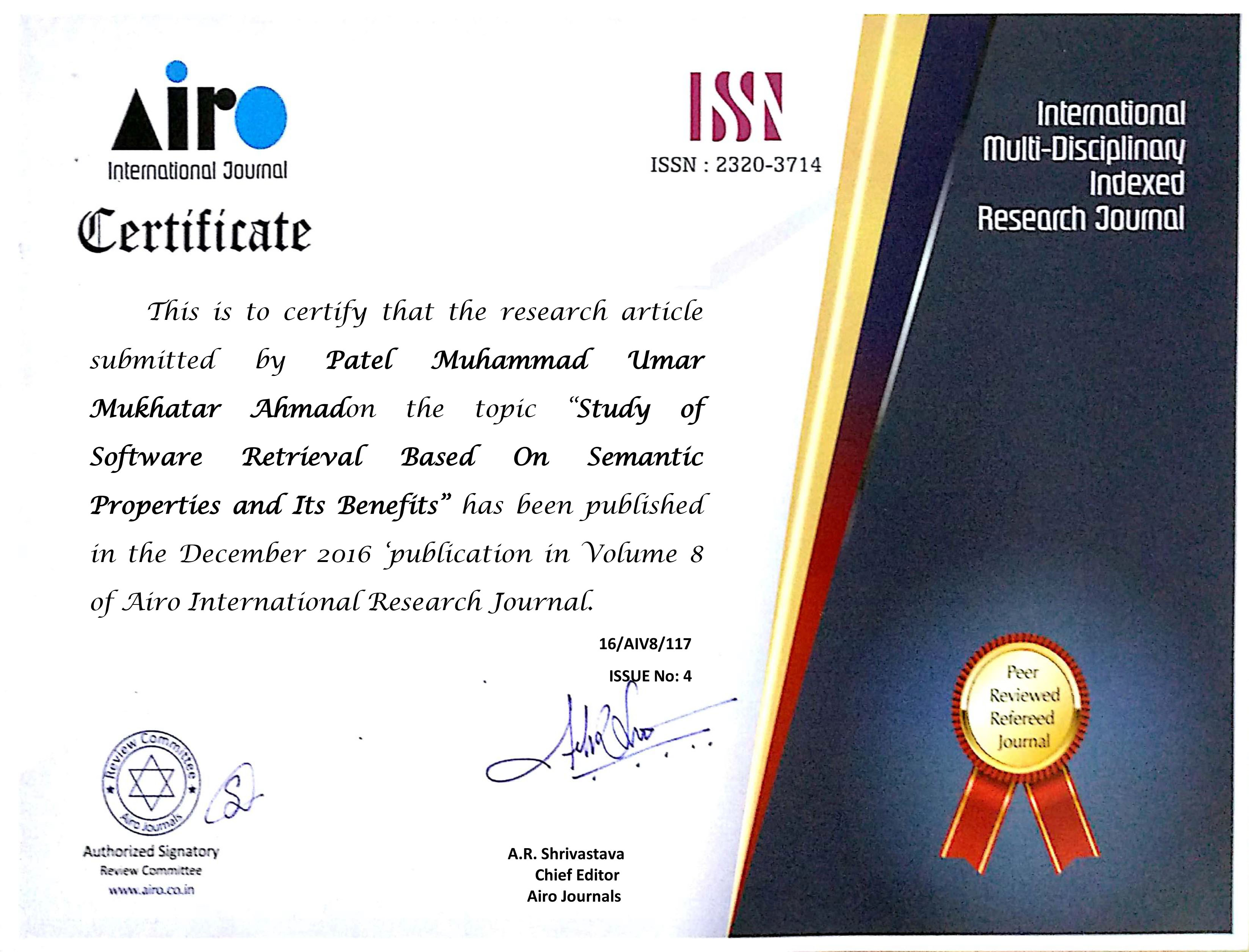
- Dec 2016
- Study of Software Retrieval Based on Semantic Properties and Its Benefits. Maps how concept relevance varies within a text to separate major from minor themes, then builds a semantic map so users can find relevant resources by navigating semantic proximity instead of keywords. Airo Int. Research Journal · Vol. 8, Issue 4 · pp. 148–158 · with Dr. Suresh Chand Tyagi
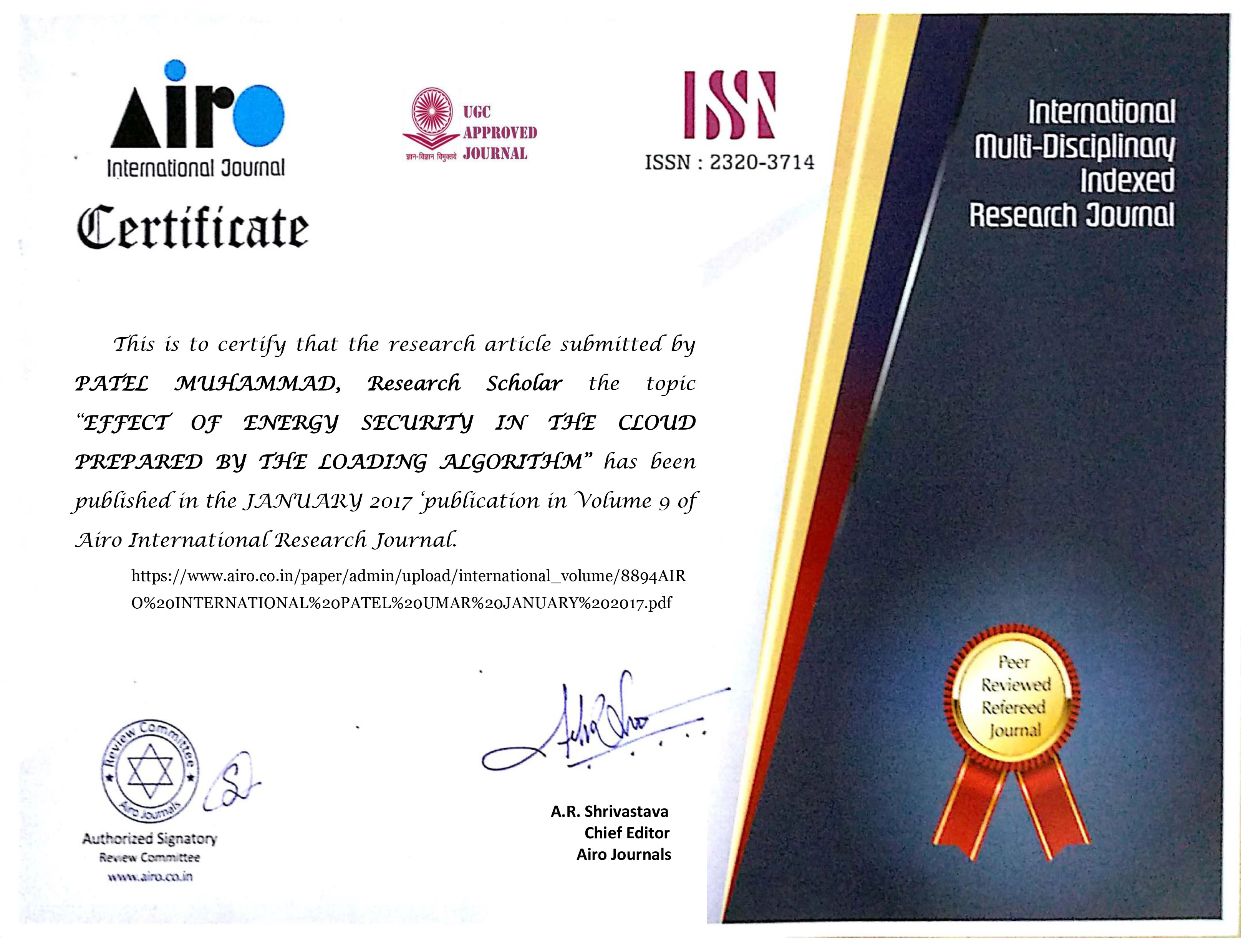
- Jan 2017
- Effect of Energy Security in the Cloud Prepared by the Loading Algorithm. Load balancing and efficient resource use to cut cloud energy consumption without degrading performance, using genetic algorithms to place virtual machines across servers. Airo Int. Research Journal · Vol. 9 · pp. 201–208 · with Dr. Suresh Chand Tyagi
- 2017
- Manage Energy Management Resources Effectively in Cloud Computing. Meeting cloud service-level agreements through effective resource management: balancing load so no host is overloaded, alongside VM migration, server consolidation and energy management. pp. 346–358 · with Dr. Suresh Chand Tyagi
Presented in 2017.
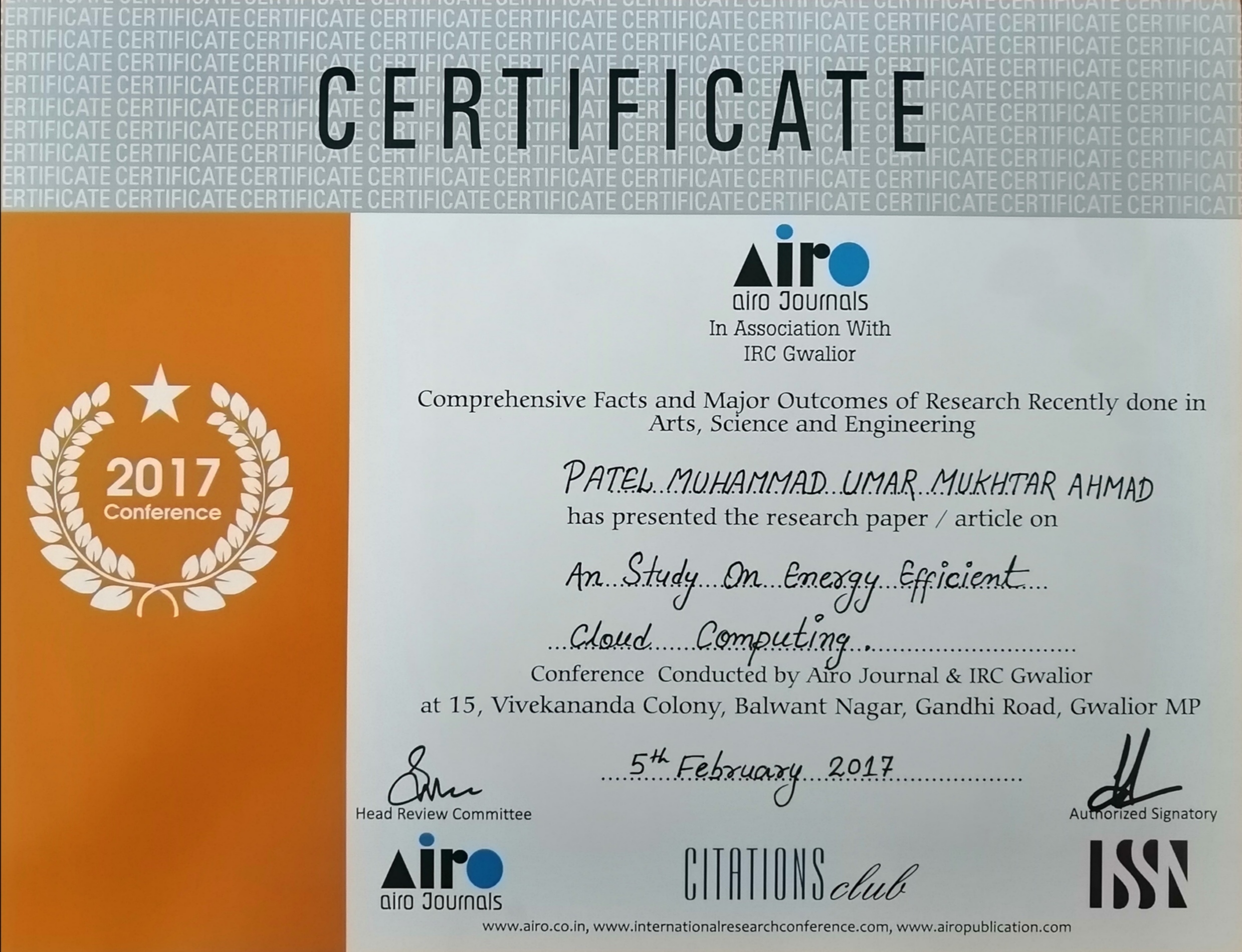
- 5 Feb 2017
- An Study On Energy Efficient Cloud Computing. Comprehensive Facts and Major Outcomes of Research Recently Done in Arts, Science and Engineering. Airo Journals · IRC Gwalior
- Gwalior
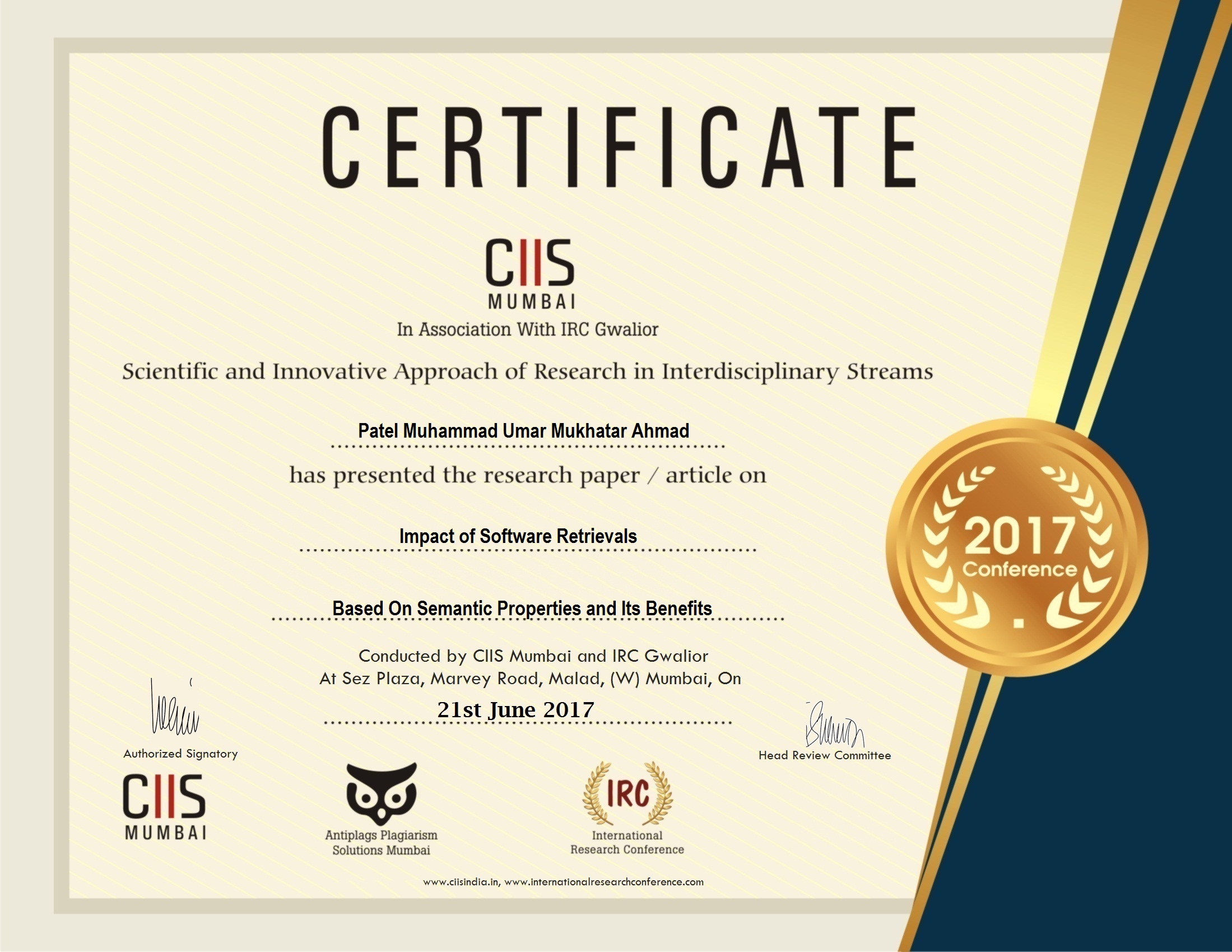
- 21 Jun 2017
- Impact of Software Retrievals Based On Semantic Properties and Its Benefits. Scientific and Innovative Approach of Research in Interdisciplinary Streams. CIIS Mumbai · IRC Gwalior
- Mumbai
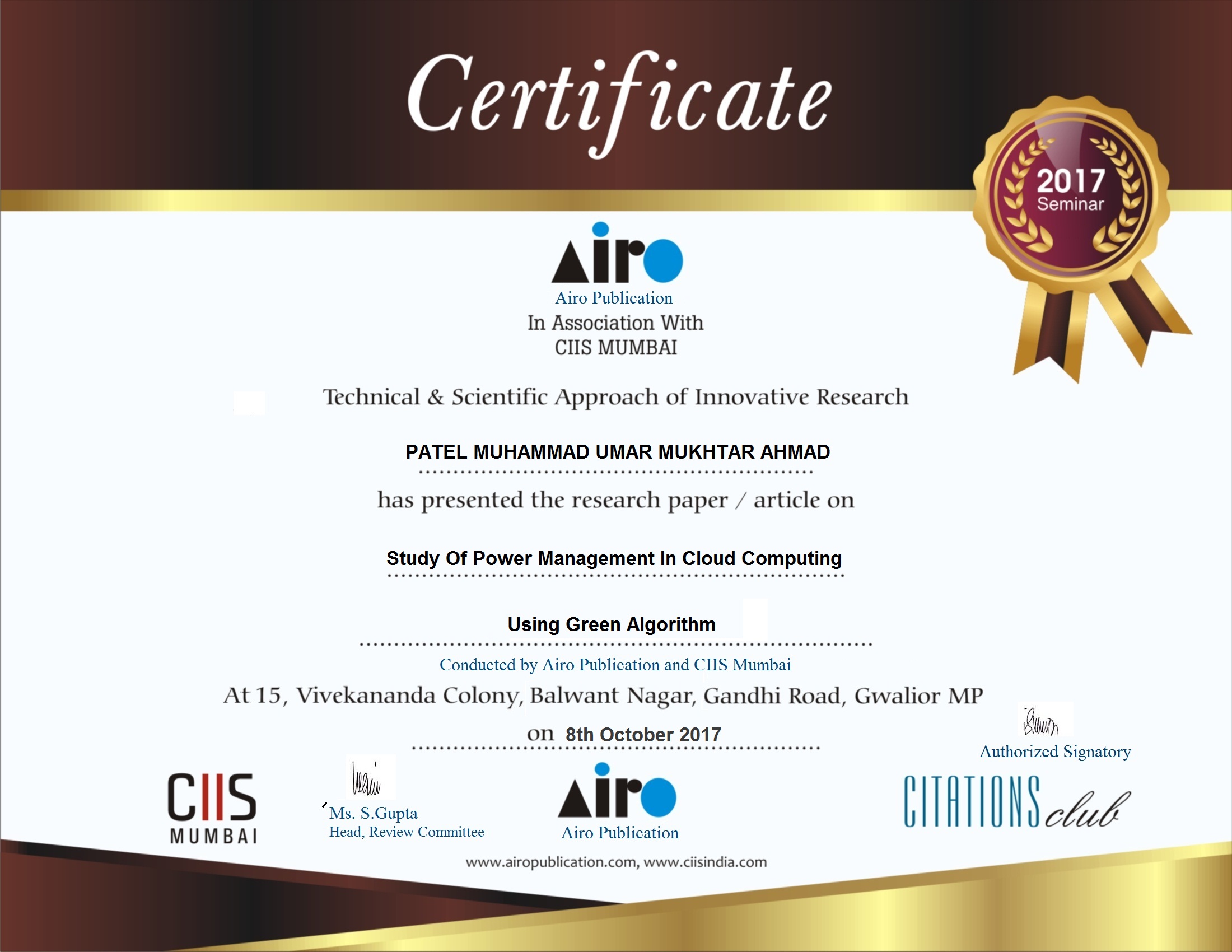
- 8 Oct 2017
- Study of Power Management in Cloud Computing Using Green Algorithm. Technical & Scientific Approach of Innovative Research. Airo Publication · CIIS Mumbai
- Gwalior
On the record.
Put AI into daily operations.
Advisory, architecture and leadership roles in enterprise AI, ERP, cloud and security. Replies within two working days.
- Phone
- +965 5777 4930
- Message
- in/mdumarp